
Updated September 18, 2026. Relay.app closed free workspaces on August 15 and paid workspaces on September 14. This guide is for people picking a replacement now, not racing a deadline.
Most "Relay alternatives" posts were written in July, in the four weeks between Relay's announcement and the first deletion date. They list the same six tools, rank them, and put the author's product at the top.
This one is organized differently. Relay was a small platform, but people used it for very different reasons, and the right replacement depends on which reason was yours. Someone who used Relay as a cheaper Zapier should not land on the same tool as someone who used it because it put a human approval step in front of every AI-drafted email.
So the first section asks what you used Relay for. The comparison table and tool profiles follow. DeskFerry is our product and appears in the sections where we think it fits; where it doesn't, we say so and name what does.
What has changed since July
Three things worth knowing if you read the earlier roundups:
Relay is gone, and so is the data. Both deadlines have passed, and Relay's homepage now confirms the shutdown. Workspaces, tables, run history, and stored app credentials were deleted. If you have an export .zip, that is what exists.
Make's migration offer has expired. Make offered free white-glove rebuilds and office-hours sessions for Relay users through September 14. That window is closed. Zapier's migration guide is still live; it's a self-serve process using their Copilot.
The agent-first tools dropped their canvases. Lindy's current site and docs no longer describe a visual builder; it now runs as a chat-first "AI employee" in Slack. Gumloop's node-based workflows are marked Legacy on its pricing page; the product is now organized around agents you configure in conversation. If you were considering either because reviews described a drag-and-drop canvas, those reviews are out of date.
Start here: what did you use Relay for?
Relay users tend to fall into one of five camps. Find yours.
"I used it as a Zapier with better pricing"
Your workflows were deterministic: new row → create record → post message. No AI judgment, maybe a filter or two.
Go to Zapier or Make. This is what they do, they do it at scale, and both can be tried free. Zapier has 9,000+ apps and a free tier of 100 tasks a month; Make has 3,000+ apps and a free tier of 1,000 credits a month. Make is cheaper per operation at volume; Zapier has the larger app catalog and the gentler learning curve. An AI agent platform is the wrong tool for this — you'd be paying for reasoning you don't need. Our workflow automation tools roundup covers more options in this camp.
"I used it for the visual canvas"
You think in boxes and arrows. You debug by looking at the flow. Compliance or a colleague needs to see the branching as a diagram.
Go to Make, or n8n if you're technical. Make is the closest living cousin to Relay's builder: node-based Scenario Builder, Routers for branching, Subscenarios for reusable pieces. Its AI builder (Maia) is in public beta and can generate scenarios from a plain-language description, including a pasted Relay build prompt. n8n offers a similar canvas and far more flexibility, at the cost of a real learning curve. None of the agent-first tools — DeskFerry, Gumloop, Lindy — will give you a canvas.
"I used it for the human approval steps"
Relay's signature feature was the approval step you could drop anywhere in a flow, so an AI could draft and a person could approve before anything went out. This is the camp where the replacement choice matters most, because the tools differ sharply.
In rough order of how well each one replaces Relay's approval step:
- Gumloop: the richest approval system in this list — per-app modes (always allow / ask each time / ask for writes and deletes), conditional rules written in plain language, approvals via Slack buttons or an in-app queue. Shipped in June 2026.
- DeskFerry: approvals are a first-class instruction. "Check with me before sending" pauses the agent and waits. Available on every plan.
- Zapier: a Human in the Loop step (Request Approval, Collect Data) that pauses a Zap for review. Not on the Free plan.
- n8n: Send-and-Wait-for-Approval operations built into the Slack, Gmail, Teams, Telegram and other nodes. Works well; requires you to wire it.
- Lindy: per-integration Guardrails — "require approval" on writes for a given tool. It's a policy, not a step in a flow.
- Make: the native Human-in-the-Loop app is Enterprise-only. On other plans you build approvals by hand with a webhook and a Slack message. If approvals were your reason for Relay, Make is the one to be careful with.
"I used it for the AI steps and agents"
Your workflows read, classified, drafted, researched, or decided. The AI was doing the work, and the other steps were plumbing around it.
Go to an agent-first platform: DeskFerry, Gumloop, or Lindy. All three take a plain-English description of the job as their primary input, which matters here because Relay's export includes a plain-English build prompt for every workflow. In Zapier or Make that prompt is something an AI assistant translates into a canvas; in these three, it's close to the finished instruction.
The differences are in shape. DeskFerry is organized around agents with triggers, schedules, and approvals, and starts at $49/month with a 7-day free trial. Gumloop is an org-wide platform with unlimited seats, a company knowledge base, and admin controls, from $37/month. Lindy is a per-seat "AI employee" that lives in Slack, from $29.99 per user per month, with no free plan. Detail on each below.
"I want to own the infrastructure"
You want the workflows on your own server, with your own API keys, and no vendor between you and the runs.
Go to n8n. It's the only tool here you can self-host, and the Community Edition is free under a fair-code license. You take on hosting, upgrades, retries, and security patches. Its AI Agent node is built on LangChain and supports memory, tools, and MCP servers, so it covers the AI camp too, if you have the engineers.
Comparison table
| Zapier | Make | n8n | DeskFerry | Gumloop | Lindy | |
|---|---|---|---|---|---|---|
| Apps | 9,000+ | 3,000+ | 500+ native; 2,000+ incl. community | 1,500+ | 300+ | 1,000+ |
| Visual canvas | Partial (tree editor; Canvas is beta) | Yes | Yes | No | Legacy | No |
| Build from plain English | Copilot (beta) | Maia (public beta) | AI Workflow Builder (cloud plans; self-hosted preview with your own key) | Agent Builder | Chat-based agent builder | Chat / Skills |
| AI agents | Zapier Agents (priced separately) | Make AI Agents (beta label on pricing) | AI Agent node (LangChain) | Core product | Core product | Core product |
| Human approvals | Human in the Loop step (not on Free) | Enterprise-only native app | Send-and-Wait in app nodes | Built in, all plans | Per-app modes + rules | Per-integration Guardrails |
| Branching / reuse | Paths, Filters, Sub-Zaps | Routers, Filters, Subscenarios | If, Switch, Sub-workflows | Described in the instruction | Skills, subagents | Skills |
| Triggers | App events, schedules | App events, schedules | App events, schedules, webhooks | App events, schedules | App events, schedules, webhooks, email, Slack | Schedules, email, Slack, meetings |
| Model choice | Zapier-managed | Make-managed | Any (BYO key on self-hosted) | OpenAI, Anthropic, Google, xAI, others | 35+ models, 8 providers, BYOK | "Model agnostic"; providers not listed |
| Free tier | 100 tasks/mo | 1,000 credits/mo | Cloud: trial only. Self-hosted: free | 7-day trial | 14-day trial | 7-day trial, Slack signups only |
| Starting paid price | $19.99/mo (annual) | $12/mo Core (annual; $16 monthly) | €20/mo Starter (annual) | $49/mo Growth | $37/mo Pro | $29.99/user/mo |
| What's metered | Tasks (AI in same pool) | Credits (AI in same pool) | Executions | Credits | Credits (tokens + tools + compute + 8% fee) | Credits (~1¢ each) |
| Self-host | No | No | Yes | No | No | No |
| Relay migration content | Live guide (Copilot rebuild) | Guide; free rebuild offer expired Sep 14 | None | Live guide | Pre-shutdown SEO post only | Pre-shutdown SEO post only |
Prices and counts checked September 18, 2026 against each vendor's own pricing or product pages. Several are in flux — see the notes in each profile.
The six alternatives
Zapier
Best for: the largest app catalog, mature governance, and teams already on Zapier.
Zapier is the incumbent and the safest default for deterministic workflows. 9,000+ apps, a Free plan with 100 tasks a month, and Professional from $19.99/month on annual billing. Tasks are the metered unit, and AI steps draw from the same pool rather than a separate credit bucket, which Zapier itself points out as a difference from Relay.
For Relay users specifically, Zapier published a migration guide in July: export your workspace, copy each workflow's build prompt, paste it into Copilot, and let it propose the Zap. Copilot is still labelled beta in Zapier's help center but is available on the Free plan. The mapping is clean — Relay Paths → Paths and Filters, Sequences → Sub-Zaps, Tables → Tables, MCP → Zapier MCP, AI reviews → Human in the Loop.
Where it falls short of Relay: the Human in the Loop step isn't on the Free plan, and Zapier's model is still trigger → fixed actions. Zapier Agents exist as a separate product with separate pricing (400 activities a month free, then $33.33/month on annual billing), so if your Relay workflows were mostly agents you'd be buying two things.
Make
Best for: people who want Relay's canvas back and don't need approvals below Enterprise.
Make is a visual, node-based builder with 3,000+ apps and the most generous free tier here (1,000 credits a month, two active scenarios). Routers handle branching and are free of credits; Subscenarios are the reusable-pieces equivalent of Relay Sequences. Maia, the AI builder, is in public beta and can generate a scenario from a pasted description.
Make had the most aggressive Relay outreach — a dedicated migration page with free white-glove rebuilds and office hours — but that offer ended September 14. The page and Maia path are still there; the engineers aren't.
The catch for Relay users: Make's native Human-in-the-Loop app is Enterprise-only. On Core, Pro, or Teams you build approvals yourself with a Slack message and a webhook. That's doable, but it's the thing Relay made effortless. Make AI Agents are listed on all plans but still carry a beta label on the pricing page.
Pricing: Core is $12/month on annual billing ($16 month-to-month), Pro $21 ($28), Teams $38 ($51), each with 10,000 credits a month. Make's own Relay migration page still quotes older plan prices, so go by the pricing page.
n8n
Best for: engineering-led teams who want control, self-hosting, and the freedom to write code in the flow.
n8n has a visual canvas, a LangChain-based AI Agent node with memory and tools, MCP client support, and Send-and-Wait-for-Approval operations built into Slack, Gmail, Teams, Telegram and other nodes. It covers every camp above — if you have the skills. Expressions, JSON, webhooks and debugging node output are part of daily use.
Two things to know. n8n prices in euros: Starter is €20/month on annual billing for 2,500 executions (an execution is one full workflow run regardless of step count). And there is no permanent free cloud tier — free means self-hosting the Community Edition, which lacks SSO, environments, credential sharing and other team features.
n8n has published nothing about Relay. Its own homepage says 500+ integrations; its integrations directory shows 2,000+ once community nodes are counted.
DeskFerry
Best for: Relay users whose workflows were AI-driven and who relied on approval steps, and who want to be running again without learning a new builder.
DeskFerry is our product, so read this with that in mind.
There's no canvas. You describe the job in plain English — trigger, steps, conditions, where to stop and ask — and DeskFerry's Agent Builder builds an agent that runs it across 1,500+ apps. Scheduling and app-event triggers, human approvals, a knowledge base (docs, URLs, databases), memory across runs, and an activity log of every run are built in on every plan. You can pick the model per agent from OpenAI, Anthropic, Google, xAI and others without managing API keys.
Why it fits Relay users: Relay's export includes a plain-English build prompt for every workflow, and that prompt is roughly the agent instruction you'd write in DeskFerry. Paste it, tighten it, reconnect the apps, test against your exported run history. Our step-by-step migration guide walks through it, including what to do if you didn't export in time.
Pricing is $49/month (Growth), $99 (Pro), $299 (Scale), unlimited agents on every plan, metered on credits (see pricing). Every plan has a 7-day free trial.
Where it isn't the right choice: if you need a canvas, if your workflows were pure data plumbing with no judgment in them (Zapier or Make will do that cheaper per run), or if you want to self-host. We'd rather you land on the right tool than churn out in a month.
Gumloop
Best for: companies rolling agents out org-wide, with IT holding the controls.
Gumloop has pivoted from a visual flow builder to an agent platform, and its approval system is the strongest in this list: per-app modes, conditional rules you can write in natural language ("only ask for emails to external domains"), an Ask Question ability that pauses with structured choices, and approvals via Slack, an inbox, or a task queue. Company Brain syncs Drive, Notion, Slack, Confluence and more into a shared knowledge base. Model choice is wide — 35+ models across 8 providers, with bring-your-own-key.
Pricing is $37/month for Pro with unlimited seats and a 14-day trial; there's no free plan. Metering is layered — model tokens, tool calls, compute time per active minute, and an 8% orchestration fee on top (16% with BYOK) — so cost per run is harder to predict than a flat task or credit count.
The Legacy label on Workflows means the canvas that older reviews describe is on its way out. Gumloop's only Relay content is a pre-shutdown alternatives post from 2025.
Lindy
Best for: teams that want an AI teammate in Slack for meetings, inbox, and daily briefs, and are fine paying per seat.
Lindy has repositioned as an "AI employee": no canvas or builder product appears on its current site — you talk to it in Slack, teach it Skills by showing it once, and set Routines on a schedule or trigger. Guardrails let you require approval on writes for any connected tool. Memory is stored as plain files you can edit. It claims 1,000+ integrations plus MCP servers.
Lindy is the least Relay-shaped of the six. The triggers its site describes are schedules, email, Slack, and meeting events; it doesn't spell out generic webhook or app-event triggers. Pricing is per user — Plus at $29.99/user/month for 3,000 credits — with no free plan and a 7-day trial only for teammates who join via Slack. The model list isn't published.
If Relay was your automation backbone, Lindy is a different kind of product. If Relay was your personal assistant for email and calendar, it's worth a look.
What about your Relay export?
No tool imports Relay's JSON — it's Relay's internal format. What every tool can use is the build prompt Relay generated per workflow: a plain-English description of the trigger, steps, conditions and approval points.
- In Zapier and Make, paste it into Copilot or Maia, which propose a Zap or scenario you finish by hand.
- In DeskFerry, Gumloop, or Lindy, it's close to the instruction you'd give the agent directly.
- In n8n, the AI Workflow Builder on cloud plans can take it; self-hosted has a preview version if you bring your own model key.
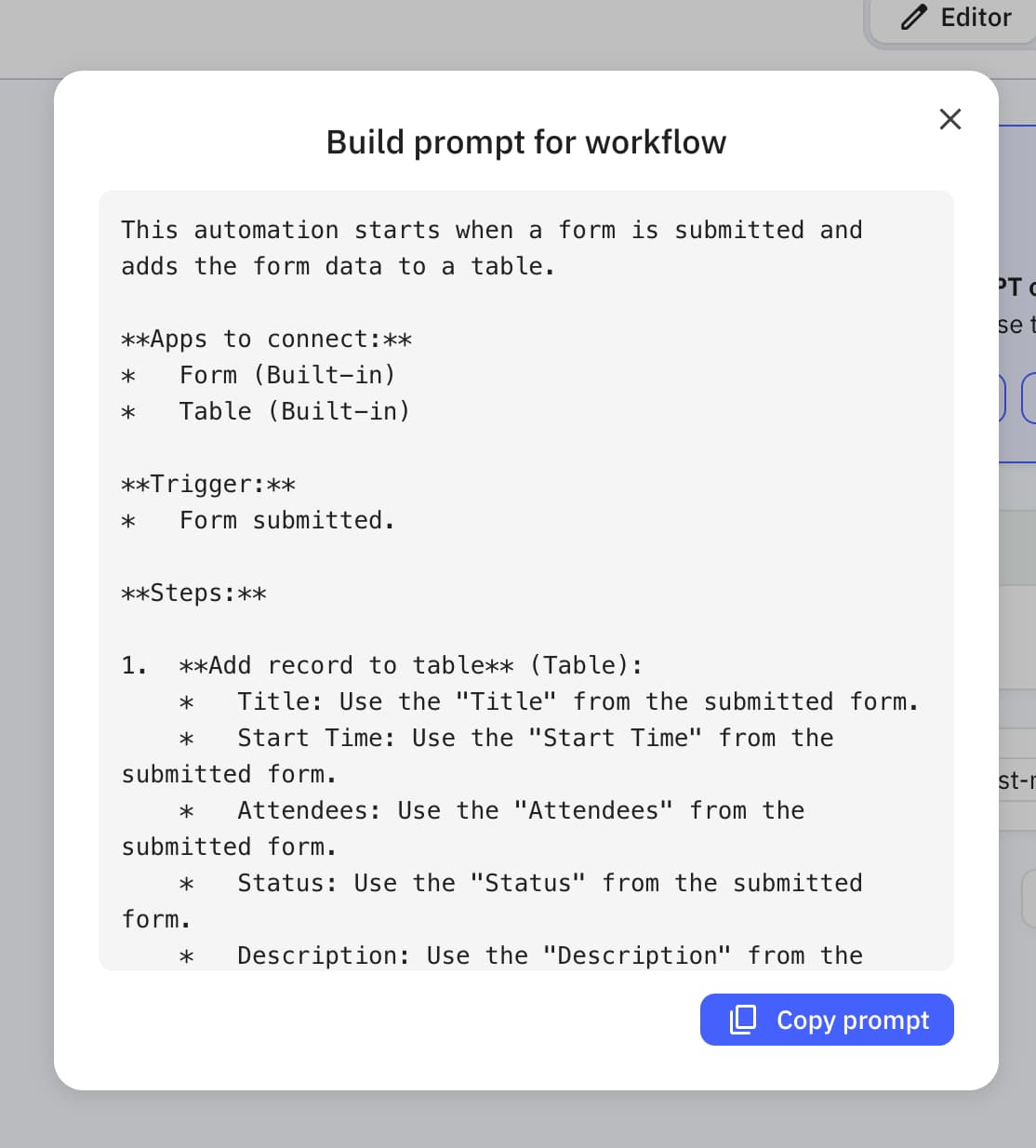
Your exported run history (CSV per workflow, JSON per run) doesn't import anywhere either, but it's the best test data you have: pick real past runs, feed the rebuilt workflow the same inputs, compare outputs.
If you didn't export, your workflows still left evidence in the apps they wrote to — the Slack channel, the Notion database, the CRM fields. That's enough to describe each job in a sentence, which is where every agent-first tool starts anyway.
Relay alternatives FAQ
Is Relay.app really gone? Yes. Free workspaces were deleted after August 15, 2026 and paid workspaces after September 14, 2026, including stored data and app credentials. Signups have been closed since July 16.
Which alternative is closest to Relay? For the canvas and branching: Make. For the approval-step-plus-AI pattern Relay was known for: DeskFerry or Gumloop. For the largest catalog and lowest risk: Zapier. There's no single tool that is Relay with a different logo.
Which ones can I try free? Zapier and Make have permanent free tiers. DeskFerry has a 7-day trial. n8n's cloud has a trial; self-hosting is free. Gumloop has a 14-day trial. Lindy's 7-day trial is only for people joining via Slack.
Which ones have a visual builder? Make and n8n. Zapier has a tree-style editor and a beta Canvas product. DeskFerry, Lindy, and (going forward) Gumloop do not.
Are any migration offers still open? Make's free rebuild offer closed September 14. Zapier's self-serve guide and DeskFerry's guide are live. No other vendor in this list has published a Relay migration path.
If your camp was "AI steps and approvals," start a free DeskFerry trial and paste your first Relay build prompt. The migration guide has the step-by-step.