You need AI agents that actually collaborate on complex tasks—not just run in sequence. CrewAI and DeskFerry both promise multi-agent automation, but they take fundamentally different approaches: CrewAI uses role-based Python teamwork, while DeskFerry offers structured no-code workflow orchestration. The wrong choice means rebuilding your entire automation stack six months from now.
Disclosure: This article is published by DeskFerry. We include our own product alongside competitors for transparency.
Picking between platforms like DeskFerry and CrewAI becomes overwhelming when you need to know which one delivers results. CrewAI stands apart from traditional automation tools by focusing on shared work between agents. It assigns specific roles like researcher or reviewer to create specialized teams that tackle complex tasks together. Both platforms take different paths to delegation and specialization, which makes your AI system flexible.
This comparison will get into how these agentic AI platforms handle tasks from marketing automation to customer support. We'll explore which solution works best for specialized tasks that benefit from agent-to-agent communication.
Core Architecture: How DeskFerry and CrewAI Build Intelligent Agents
AI agent platforms like DeskFerry and CrewAI work differently because of their basic architectural differences. Both platforms create intelligent agents that can make decisions without constant human input, but their approaches vary.
Agent Design: Role-based vs Workflow-based Models
CrewAI uses a role-based architecture where agents work like team members with specific jobs. This setup mirrors how human teams work – each agent has its own role and contributes to team goals. Agents work together as one unit, each with its own tools and clear goals.
DeskFerry takes a different path with its workflow-based model. According to Anthropic, "Workflows are systems where LLMs and tools are orchestrated through predefined code paths". This well-laid-out approach gives better control and predictability, which helps when tasks need consistent results.
The main difference shows in how they work: CrewAI's agents act like independent team specialists, while DeskFerry sticks to careful, planned steps.
LLM Integration: Model Choice on Both Sides
CrewAI works with many LLM providers through LiteLLM. You can choose from:
- OpenAI models
- Google models (Gemini series)
- Amazon Bedrock models (Nova family)
Teams can pick models that match their needs for accuracy, speed, and budget.
DeskFerry also lets you choose: bring your own model provider, including OpenAI, Anthropic, Gemini, Amazon Bedrock, Perplexity, and xAI. The difference is that DeskFerry handles the plumbing for you, so switching models doesn't mean rewriting code.
Tooling and API Access: Built-in vs Customizable
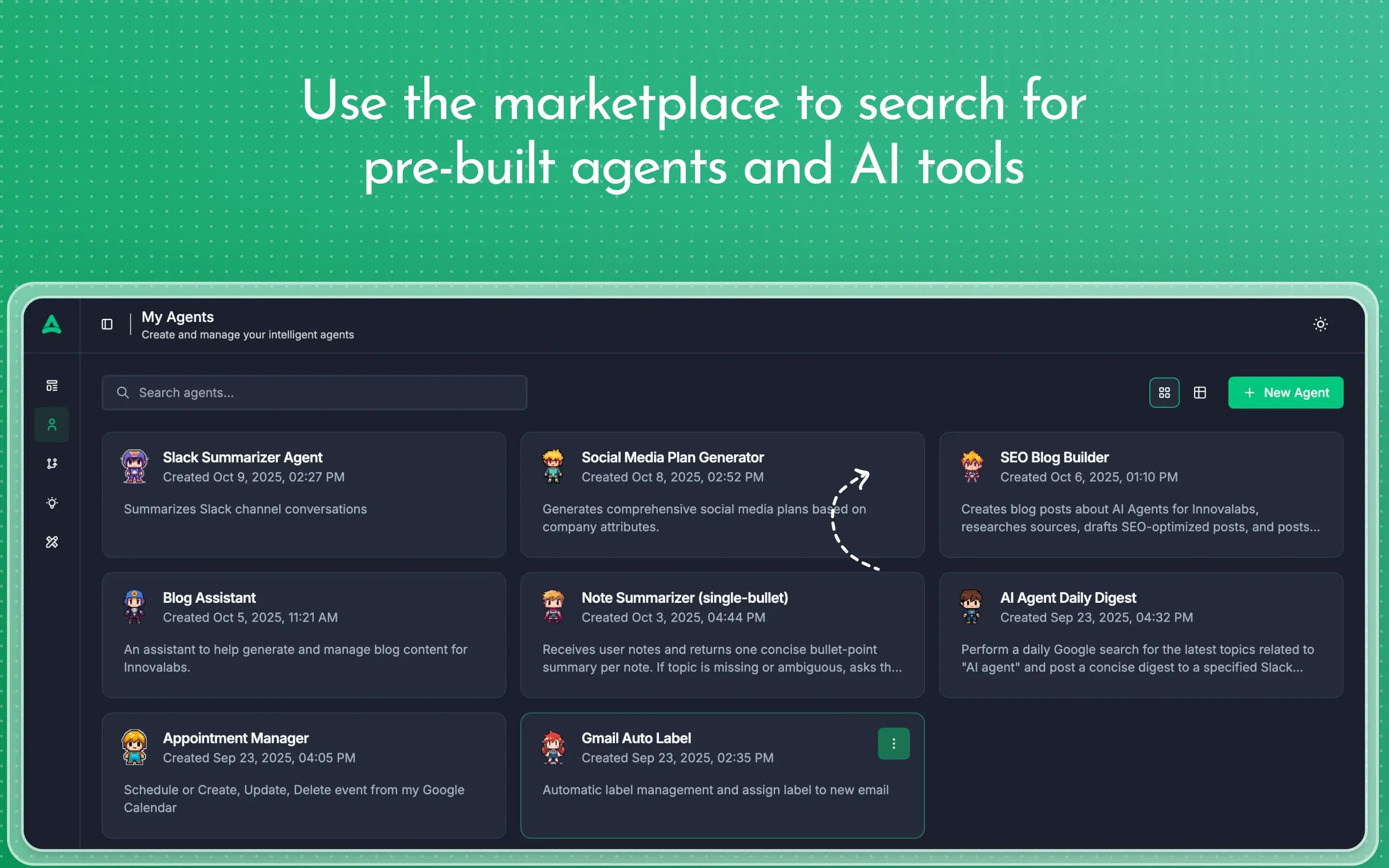
DeskFerry comes with 1,500+ ready-made app integrations via Composio, plus 200+ templates and an agent marketplace. Agents can take actions across those tools, with human-in-the-loop approvals for anything sensitive.
CrewAI lets developers create and add their own tools. This flexibility works great when you need special features or want to connect with your own systems.
These platforms show different views on agent design. CrewAI focuses on teamwork and specialized roles. DeskFerry builds structured workflows with reliable execution.
Workflow Automation and Task Delegation
Task management is the foundation of how AI agents operate in complex environments. DeskFerry and CrewAI each take unique approaches to organizing agent workflows and managing tasks.
Multi-Agent Coordination: Sequential vs Parallel Execution
DeskFerry uses a sequential orchestration pattern. Their agents work in a predefined, linear order. Each agent takes the previous agent's output and creates a pipeline of specialized transformations. This method works best for multistage processes that have clear linear dependencies.
CrewAI takes a different path with its parallel execution capabilities. Their model lets multiple agents work together on independent subtasks at the same time. This can substantially reduce overall processing time when tasks run independently.
Trigger Systems: Event-Driven vs Manual Task Assignment
DeskFerry features an event-driven automation system that launches automatic actions based on specific events like user inputs or system alerts. Their agents respond to changes in their environment, so workflows run without constant manual oversight.
CrewAI uses a well-laid-out task assignment model. A manager agent distributes work based on team member expertise and current workload. The platform also makes shared expertise possible between humans and AI through a simple human input flag.
Memory and Context Handling: Persistent vs Stateless Agents
DeskFerry runs as a stateful system that remembers information across interactions. This lasting memory helps agents understand context, adapt on the fly, and get better over time. Such features make them valuable for applications that need personalization and continuity.
CrewAI provides memory modules (short-term, long-term, and entity memory) that developers configure in code. That gives fine-grained control, but persistence and storage are yours to set up and maintain.
Real-World Use Cases: Where Each Platform Excels
AI agents prove their worth through specific business applications. Each platform brings unique benefits based on the use case and needed functionality.
Marketing Automation: Content Pipelines and Campaigns
CrewAI stands out in collaborative content creation with its role-based marketing approach. The framework helps specialized AI agents work as a unified marketing team. Each agent handles different parts of campaign development.
DeskFerry uses its workflow-based structure to make end-to-end campaign execution more efficient. The platform handles complex promotion tasks without breaking a sweat. Marketers who use DeskFerry can create campaigns faster through automated briefs, target segment identification, email and SMS content creation, and customer experience building—with minimal human input.
Customer Support: Ticket Routing and Resolution
CrewAI excels at creating automated customer service ensembles where multiple agents tackle complex support problems together. The platform's structure allows agent roles to mirror human support teams.
DeskFerry's main strength comes from its AI-powered ticketing systems integration. The platform sorts and directs incoming tickets to the right agents, enabling faster responses and quicker resolution than manual methods.
Research and Analysis: RAG and Data Extraction Workflows
CrewAI shows impressive results with multi-agent research teams that analyze complex data sets together. Researchers can create specialized agent teams that extract, analyze, and blend information from different sources.
DeskFerry works well with Retrieval Augmented Generation (RAG) systems that connect company content through vectorized documents. This helps ground AI responses in reliable company data.
Performance, Scalability, and Customization
Technical performance plays a significant role in scaling ai agents. DeskFerry and CrewAI handle infrastructure needs differently, each with its own advantages based on deployment needs.
Execution Speed and Latency
DeskFerry employs cloud-native architecture that puts elasticity first. Resources can expand or shrink based on workload. Teams can scale their operations smoothly during seasonal changes or unexpected spikes.
CrewAI gives you both cloud and local processing choices, which makes it flexible for different setups. Local AI processing gives you near-zero latency because it handles data on your own infrastructure.
Operational Differences:
| Metric | DeskFerry | CrewAI |
|---|---|---|
| Response time | Depends on chosen model | Depends on chosen model and your infrastructure |
| Hosting | Managed cloud | Self-hosted, or CrewAI's managed offering |
| Scalability | Managed by DeskFerry | Your infrastructure management (self-hosted) |
Customization and Integration Capabilities
Both platforms offer extensive customization, but through different approaches:
DeskFerry:
- Pre-built integrations with 1,500+ applications via Composio
- 200+ templates and an agent marketplace
- No-code customization options
- Enterprise-grade security
- Human-in-the-loop approvals, in the web app or the DeskFerry Slack app
- Managed infrastructure
CrewAI:
- Highly customizable agent roles and behaviors
- Open framework for custom tool development
- Python-based customization
- Flexible deployment options
- Full control over code and infrastructure
- Community-driven tool library
Pricing Comparison: Total Cost of Ownership
DeskFerry Pricing Structure
DeskFerry is priced per plan, not per user, with unlimited agents on every plan and a 7-day free trial.
Growth Plan: $49/month
- 5,000 credits per month
Pro Plan: $99/month (Most picked)
- 12,000 credits per month
Scale Plan: $299/month
- 40,000 credits per month
Credit top-ups are available if you need more. See pricing for full details.
CrewAI Pricing Structure
Free (Open Source):
- Full framework access
- Self-hosted
- Community support
- All features available
- Cost: Your infrastructure + LLM API costs
CrewAI managed/enterprise offering: check CrewAI's current pricing.
Hidden Costs to Consider:
CrewAI (self-hosted) monthly cost drivers:
- Cloud infrastructure (AWS/GCP or similar)
- LLM API usage
- Developer time for maintenance
DeskFerry monthly cost:
- Platform subscription: $49-$299
- No infrastructure costs
- No maintenance overhead
Developer Experience and Learning Curve
DeskFerry: No-Code Approach
Required Skills:
- None (describe agents in plain English)
- Basic understanding of workflows
- Familiarity with business processes
Setup Process:
- Sign up and start the 7-day free trial
- Connect integrations via OAuth
- Create first agent from a template
- Test and deploy
- Monitor performance (ongoing)
Pros:
- No coding required
- Immediate productivity
- Pre-built templates
- Run history for every run
Cons:
- Less flexibility for custom logic
- Limited to platform capabilities
- Vendor lock-in concerns
CrewAI: Code-First Approach
Required Skills:
- Python programming
- API integration knowledge
- Understanding of AI/ML concepts
- DevOps basics (for deployment)
Setup Process:
- Install Python and dependencies
- Learn framework concepts
- Write agent configuration code
- Set up infrastructure
- Deploy and test
- Monitor and maintain (ongoing)
Pros:
- Complete control and flexibility
- No vendor lock-in
- Custom tool development
- Open source transparency
Cons:
- Steep learning curve
- Requires development resources
- Infrastructure management overhead
- No built-in UI
Security and Compliance
DeskFerry Security Features
Enterprise-Grade Security:
- Enterprise-grade security on a managed cloud platform
- Data protection best practices
- Human-in-the-loop approvals for sensitive actions
Data Handling:
- Data processed in secure cloud infrastructure
- Sensitive and regulated data can stay in your own compliant systems; agents act on it through your integrations
CrewAI Security Considerations
Self-Hosted Security:
- You control all security measures
- Data stays in your infrastructure
- Custom security implementation required
- Compliance is your responsibility
Third-Party Dependencies:
- Security depends on LLM provider (OpenAI, etc.)
- Must implement own access controls
- Require monitoring and logging setup
- Vulnerability management needed
Use Case Decision Matrix
| Your Scenario | Recommended Platform | Why |
|---|---|---|
| Small business, non-technical team | DeskFerry | No-code, fast setup, managed infrastructure |
| Startup with developers | CrewAI | Flexibility, cost control at small scale |
| Strict data-residency or self-hosting mandate | CrewAI | Runs on your own infrastructure |
| Custom AI research project | CrewAI | Full control, custom models |
| Marketing automation | DeskFerry | Pre-built integrations, templates |
| Complex multi-agent coordination | CrewAI | Advanced agent collaboration |
| Customer support | DeskFerry | Quick deployment, integrations |
| Technical team, unique requirements | CrewAI | Maximum customization |
Conclusion: Choosing the Right Platform
The choice between DeskFerry and CrewAI depends on your organization's specific needs:
Choose DeskFerry if you need:
-
Quick deployment with minimal technical expertise
-
Extensive pre-built integrations
-
Enterprise-grade security on managed infrastructure
-
Predictable workflow execution
Choose CrewAI if you need:
- Highly customizable multi-agent teams
- Complex collaborative workflows
- Technical flexibility and control
- Custom tool development capabilities
Both platforms represent the forefront of agentic AI technology, each with its own strengths for different use cases and organizational requirements.
Related: CrewAI alternatives · DeskFerry vs Relevance AI · DeskFerry vs n8n · Best AI agents for business 2026 · No-code AI agent builder guide