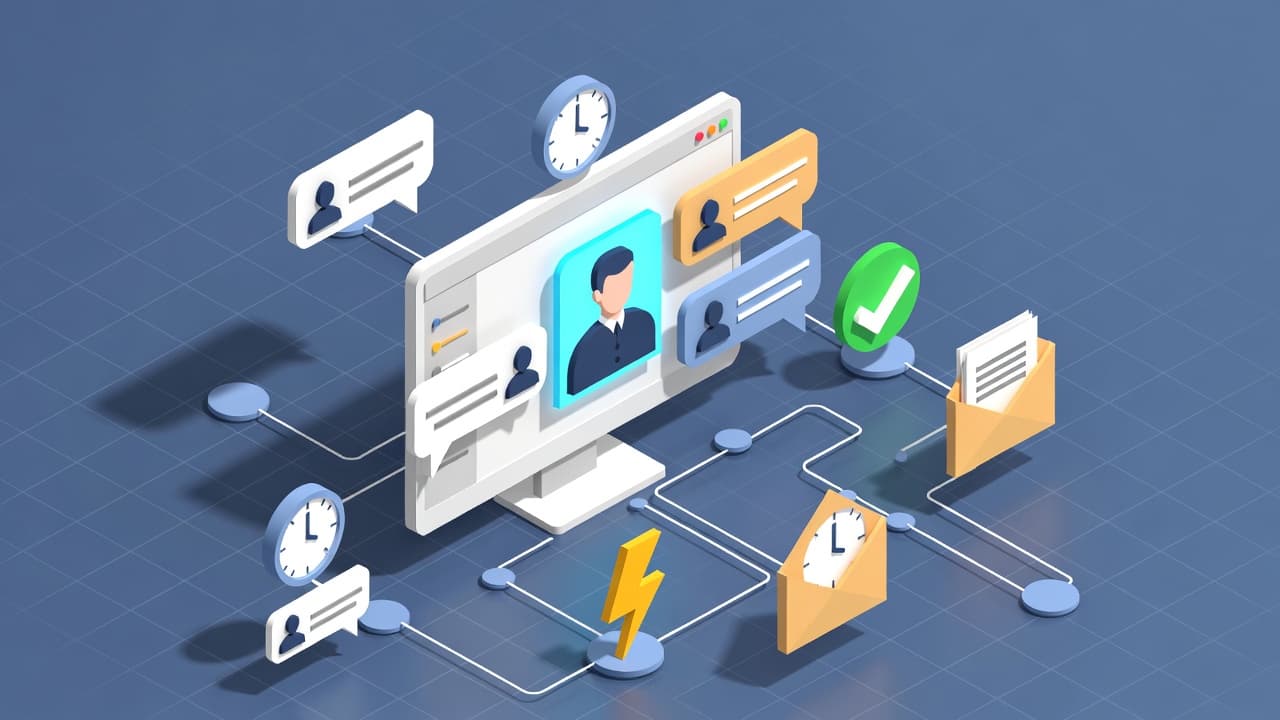
Ask a support community which AI agent to buy and the answers rarely name one winner. They ask what helpdesk you're on, how many tickets you get, and whether you sell physical products. That's the right instinct: AI support agents split into a few lanes, and the best one in each lane is different.
This guide compares 11 AI agents for customer support inside four lanes, with pricing checked on each vendor's own page in October 2026. It also turns the questions buyers keep asking (what you're billed for, what happens when the bot is wrong, how handoff works) into a checklist you can take into a demo.
Disclosure: This article is published by DeskFerry. DeskFerry is included as one option. It is an AI agent platform, not a helpdesk, and we say below where the dedicated support tools beat it.
AI support agent vs chatbot: what are you actually buying?
A support chatbot answers questions from a script or a set of articles. An AI support agent reads the conversation, looks things up in your systems, and can take actions such as checking an order, updating an address or starting a refund, then hands off to a person when it should. If you want the longer explanation, read AI agent vs chatbot.
Two things are true of almost every product below:
- It's only as good as your content. The agent answers from your help centre, past conversations and the data you connect. Thin or outdated articles produce thin or wrong answers.
- It sits next to a helpdesk, not instead of one. Tickets, queues, SLAs and reporting for your human team still live in the helpdesk. Some vendors sell both; some sell only the agent.
How we compared
We compared tools within each lane using vendor pricing pages, billing documentation and product pages checked in October 2026. We looked at:
- Billing model: per seat, per resolution, per session or quote only, and what counts as billable.
- Where it works: which helpdesks, channels and commerce platforms it connects to.
- Actions and handoff: whether it can do things in your systems, and how it passes a conversation to a human.
- Who it's built for: team size and the kind of support operation it assumes.
We did not run our own benchmark. Vendors publish resolution rates measured in different ways, so we haven't repeated them here; your rate depends on your content and your ticket mix.
Quick comparison
| Lane | Tool | Best for | Pricing (October 2026) |
|---|---|---|---|
| Built into your helpdesk | Fin (Intercom) | Intercom users, or any helpdesk Fin connects to | $0.99 per outcome; 50-outcome monthly minimum on other helpdesks |
| Built into your helpdesk | Zendesk AI agents | Zendesk teams | Plans from $19/agent/mo annual; 5 to 10 automated resolutions per agent included, then $2.00 each pay-as-you-go |
| Built into your helpdesk | Freshdesk Freddy | Freshdesk teams | Plans from $19/agent/mo annual; 500 AI Agent sessions free once per account, then $49 per 100 |
| Built into your helpdesk | Help Scout AI Answers | Small teams on a shared inbox | Plans from $25/user/mo; AI Answers $0.75 per resolution |
| Ecommerce | Gorgias | Shopify and BigCommerce stores | Basic from $50/mo annual; AI Agent about $0.90 to $1.00 per automated interaction |
| Enterprise | Decagon | Large brands, chat + email + voice | Quote only |
| Enterprise | Sierra | Large brands, outcome-based contracts | Quote only (outcome-based) |
| Enterprise | Ada | Large brands, voice + messaging + email | Quote only |
| Website bot | Tidio Lyro | Small sites and stores | Free plan (50 Lyro conversations, lifetime); Lyro from $32.50/mo |
| Website bot | Chatbase | A docs-trained bot on your site | From $32/mo (yearly), 700 message credits |
| Agent platform | DeskFerry | Agents that act across many tools, with approvals | 7-day free trial, then from $49/mo |
Lane 1: AI built into (or made for) your helpdesk
If you already run a helpdesk, start here. The agent sees your tickets and articles without a migration, handoff lands in the same inbox your team works from, and reporting stays in one place.
1. Fin (Intercom) — Best overall AI support agent
Pricing
$0.99 per outcome. On another helpdesk there's a 50-outcome monthly minimum; on Intercom, add a helpdesk seat (Essential is listed at $19 per seat a month for new customers, Advanced $85, Expert $132). 14-day trial (Fin pricing, Intercom pricing).
What it does. Fin is the AI agent from the company formerly called Intercom, which renamed itself Fin in May 2026. It answers across chat, email and other channels, and can run multi-step procedures that call your systems. It works inside Intercom and also on top of other helpdesks: the pricing page names Salesforce, HubSpot, Freshworks, Dixa, Front, Zoho, Sprinklr and Gorgias. Salesforce agreed to buy Fin for about $3.6 billion in June 2026 and completed the deal on September 10, 2026. Fin now runs within Salesforce AI Labs alongside Agentforce and says it will keep serving existing customers, but ask how that affects your roadmap and contract terms if you're signing a multi-year deal.
What counts as an outcome. Intercom's billing article counts a resolution when the customer confirms the answer helped or leaves without asking for more help after Fin's answer. It does not bill when the customer asks for a human, when escalation rules hand off, or when Fin couldn't answer and a teammate replied.
Not for you if
your bill needs to be predictable month to month. Per-outcome pricing goes up as Fin succeeds, and the "assumed" resolution rule is the most argued-about part of it (more below).
2. Zendesk AI agents — Best if you're already on Zendesk
Pricing
Support Team $19, Suite Team $55 and Suite Professional $115 per agent a month billed annually. Team plans include 5 automated resolutions per agent a month and Professional 10; extra automated resolutions are $2.00 each pay-as-you-go, or cheaper on a commitment. Copilot is $50 per agent a month. 14-day trial (Zendesk pricing).
What it does. Zendesk includes AI agents in every Support and Suite plan. They answer from your help centre and can be set up to run workflows, with handoff to your agents inside the same workspace. Copilot, the agent-assist side (suggested replies, summaries), is a separate add-on.
Not for you if
you're a small team with high volume. The included resolutions scale with agent seats, so a lean team handling lots of tickets will pay mostly at the per-resolution rate.
3. Freshdesk Freddy AI Agent — Best value for Freshdesk teams
Pricing
Growth $19, Pro $55 and Enterprise $89 per agent a month billed annually. Every plan includes the first 500 AI Agent sessions, but that's a one-time allowance per account, not monthly; after that sessions are $49 per 100. Copilot is $29 per agent a month. 14-day trial (Freshdesk pricing).
What it does. Freddy AI Agent answers customers on Freshdesk's channels from your knowledge base, with Freddy Copilot helping your human agents on Pro and Enterprise.
Not for you if
you want to know your cost per resolution. Freddy bills sessions, and a session isn't the same thing as a solved ticket.
4. Help Scout AI Answers — Best for small teams that want a simple bill
Pricing
Standard $25, Plus $45 and Pro $75 per user a month, with a free plan for up to 5 users and 100 contacts a month. AI Answers is $0.75 per resolution, charged once per conversation, with monthly spending caps available, and the first 3 months are free (Help Scout pricing).
What it does. Help Scout is a shared inbox plus help centre (Docs). AI Answers responds to customers from your Docs and other sources and passes to your team when it can't help.
Not for you if
you need deep, multi-step actions in back-end systems. It's strongest at answering from content.
Lane 2: Ecommerce
5. Gorgias: Best for Shopify and BigCommerce stores
What it does. Gorgias is a helpdesk built for online stores. Its AI Agent handles support and pre-sale questions, with Shopify and BigCommerce integrations so order data sits next to the conversation, plus SMS and voice channels.
Pricing. Starter $10 a month (monthly only), Basic $50, Pro $300 and Advanced $750 a month billed annually, priced by included helpdesk tickets (300 on Basic). The AI Agent is about $0.90 per automated interaction on annual contracts and $1.00 on monthly, with $1.50 for interactions beyond a plan's included allowance. Each AI interaction also counts as a helpdesk ticket. 7-day trial (Gorgias pricing). The pricing page can show combined helpdesk-plus-AI totals by default, so check which figure you're looking at.
Not for you if you're a SaaS or services business. Its strengths are orders, returns and product questions.
Lane 3: Enterprise AI agent platforms
These vendors sell to large companies with high volume, several channels including phone, and complex procedures (identity checks, billing changes, bookings). Expect a sales process, a pilot and a quoted contract.
6. Decagon: Best for enterprise teams that want to build and test their own procedures
Decagon is a customer service agent platform across chat, email and voice. You write "Agent Operating Procedures" in natural language, then test them with simulations and live A/B experiments, and monitor quality with always-on QA. Its customer list is big consumer and fintech brands. No public pricing (Decagon).
7. Sierra: Best for outcome-based enterprise contracts
Sierra builds AI customer agents for large companies in financial services, telecoms, retail, travel and more, deployed across chat, SMS, WhatsApp, email and voice from one agent. It advertises outcome-based pricing, meaning you pay for results rather than conversations, but publishes no prices (Sierra).
8. Ada: Best for enterprise voice and messaging together
Ada sells AI customer service across voice, messaging and email to large enterprises in sectors such as ecommerce, financial services, insurance, SaaS and travel. Pricing comes after a demo, with an ROI model built on your volume (Ada pricing).
Not for you if (all three) you're a small team. These are built for operations with dedicated support leadership and, often, an implementation team.
Lane 4: Website bots for small businesses
9. Tidio Lyro — Best free starting point for a small site
Pricing
A free plan with 50 billable conversations, and Lyro's first 50 conversations are free for the lifetime of the account (not per month). Starter is $24.17 a month, Growth from $49.17, Plus from $300 plus usage; standalone Lyro starts at $32.50 a month for 50 Lyro conversations. Paid plans have a 7-day trial (Tidio pricing).
What it does. Tidio combines live chat, ticketing and Flows (rule-based automations) with Lyro, its AI agent that answers from your content.
Not for you if
your support involves multi-step processes. It's best for FAQs and simple pre-sale questions.
10. Chatbase — Best for a docs-trained bot you control
Pricing
Hobby $32, Basic $120 and Business $400 a month billed yearly, with 700, 4,000 and 15,000 message credits respectively and one agent each; extra agents are $300 a year. 7-day trial on paid plans (Chatbase pricing).
What it does. Chatbase trains an AI agent on your website, docs and files and puts it on your site. The Basic and Business plans add a Chatbase helpdesk inbox and integrations with Zendesk, Salesforce, Intercom, Freshdesk, Gorgias and others for handoff; the entry Hobby plan doesn't include them.
Not for you if
you need a full helpdesk. You'll still want one behind it for the conversations it hands off.
Agent platform: DeskFerry
11. DeskFerry: Best for support work that spans many tools
What it is (and isn't). DeskFerry is an AI agent platform for customer support work, not a helpdesk. You describe an agent in plain English, connect it to the tools it needs from 1,500+ integrations (your helpdesk, Shopify, Stripe, your CRM, Notion and so on), and put it on your site with the embeddable chat widget. Agents can be set to wait for your approval before they send a reply or change anything, every run is logged in run history, and you can manage and approve them from Slack. There are ready-made templates in the marketplace, including support jobs such as a customer support agent.
Pricing. 7-day free trial, then Growth $49 a month (5,000 credits), Pro $99 (12,000) or Scale $299 (40,000). Priced per plan, not per user or per resolution, with unlimited agents on every plan. See pricing.
Where others beat it. DeskFerry has no ticket queues, SLAs, agent seats or support reporting, so it doesn't replace Zendesk, Freshdesk or Help Scout. It has no voice or phone agent, so the enterprise lane wins if phone support matters. And if all you want is an AI that answers from your help centre inside your existing helpdesk, the built-in options above are less work to set up.
Good fit if your "support" work is really cross-tool work: checking a subscription in Stripe, updating the CRM, posting an internal Slack alert, triaging tickets into the right queue, or drafting replies that a person approves before they go out.
What support teams say on Reddit and in vendor communities
The searches that land people on Reddit ("best AI agent for customer support reddit") are looking for the unvarnished version. The question is usually some version of: which agents work for a real business, are easy to set up, and don't cost a fortune? Replies in subreddits like r/AI_Agents and r/SaaS, and in vendor communities, rarely crown one tool. Instead, four worries come up again and again, and they're the right ones to have.
1. "What exactly am I being billed for?" Per-resolution pricing is the biggest complaint. The idea is fair (pay when the bot helps), but the definition matters. Under Intercom's rules, a customer who reads Fin's answer and simply leaves counts as a resolution. In an Intercom Community thread on Fin's "assumed resolved" pricing, a support lead described being charged when a teammate stepped in after a wrong answer, and paying for generic replies during an outage. Intercom staff explained how resolutions are counted and suggested better content and switching Fin off during incidents. The lesson applies to every vendor: get the billing definition in writing and model the bill at your volume, including the success case.
2. "Will it make things up?" Wrong answers delivered confidently are what make customers angry and support leads nervous. The common advice: restrict the agent to your own content, keep it out of topics where a wrong answer is costly (legal, medical, account security), and make "I'm not sure, let me get a person" an acceptable answer.
3. "Can customers reach a human?" Nobody wants to be trapped in a bot loop. Look for an obvious "talk to a person" route, handoff that passes the full conversation so the customer doesn't repeat themselves, and rules that escalate on frustration or on topics you choose.
4. "Is my knowledge base good enough?" The most practical replies point out that the agent is a mirror of your help content. If articles are out of date, contradict each other or don't cover your top ticket types, fix that first. Several vendors let you train on past conversations, which helps, but it also teaches the bot your old mistakes.
Buyer checklist: questions to ask in every demo
Use these when you shortlist two or three tools.
Billing
- What exactly counts as a billable resolution, outcome, session or interaction?
- Am I billed if the customer goes silent? If a teammate also replies? If the customer later reopens the ticket?
- Is there a minimum, a cap, or a committed-volume discount? What does the bill look like if the bot gets better?
- Does an AI interaction also count against my helpdesk ticket allowance?
Accuracy
- Can I restrict answers to approved sources only?
- Can I test it on a sample of my real past tickets before it goes live?
- How do I see and correct a wrong answer, and how fast does the fix take effect?
Handoff
- How does a customer ask for a person, and is that billed?
- Does the human see the whole conversation and what the agent already tried?
- Can I force handoff for certain topics, customers or moods?
Actions and control
- Which actions can it take in my systems (refunds, order changes, account updates)?
- Can I require approval for some actions, or set limits such as a refund ceiling?
- Is there a log of every conversation and action?
Fit
- Does it work with my current helpdesk, or does it want me to switch?
- Which channels does it cover: chat, email, SMS, WhatsApp, voice?
For the rollout itself (auditing ticket types, preparing content, running in a supervised mode first, then widening), follow our guide to reducing customer support response time with AI. If most of your support arrives by email rather than chat, compare the inbox triage tools too, and for role-based agents beyond support, see the best AI employee software.
How to choose: a quick decision guide
- You're on Intercom, or on a helpdesk Fin supports, and want the most capable packaged agent: Fin.
- You're on Zendesk: start with Zendesk's included AI agents, then compare Fin on top of your helpdesk once you know your volume. Our Intercom vs Zendesk vs DeskFerry comparison goes deeper.
- You're on Freshdesk: Freddy AI Agent, since it's already in your plan and the first 500 sessions are free.
- You're a small team on a shared inbox: Help Scout with AI Answers.
- You run a Shopify or BigCommerce store: Gorgias.
- You're an enterprise with phone support and complex procedures: shortlist Decagon, Sierra and Ada and run a paid pilot.
- You just need a bot on your website: Tidio Lyro or Chatbase.
- You need an agent that works across many tools and checks with you before acting: DeskFerry, alongside your helpdesk. For non-support agents too, see best AI agents for business.
The bottom line
The best AI agent for customer support is the one that fits your helpdesk, your volume and your tolerance for a variable bill. For most teams that means the AI built for the helpdesk they already use, with Fin the strongest packaged option and Gorgias the default for stores. Whatever you pick, the deciding factors are the ones support teams keep raising: a clear billing definition, answers grounded in good content, and an easy way to reach a person.